


3 small business marketing decisions you’re overthinking
THE DAY THAT NEVER ENDS
In 1997, a year after Amazon went public, Jeff Bezos wrote a letter to shareholders that the company reprinted, unchanged, at the back of every annual letter for the next two decades.*1 The letter set a single standard for the business: stay in “Day 1.”
He gave the alternative its own definition almost twenty years later. Day 2, he wrote, is stasis — the kind of comfortable plateau that looks like stability from the inside. What follows is irrelevance, then a slow and painful decline, then death.*2 It moves quietly enough that most companies miss it until reversing course is no longer an option.
A service business reaches its own version of Day 2 without any single dramatic moment. The same three offers running for two years, the same homepage headline, an unofficial rule that any new idea needs to feel certain before it goes live.
THE DOOR TEST
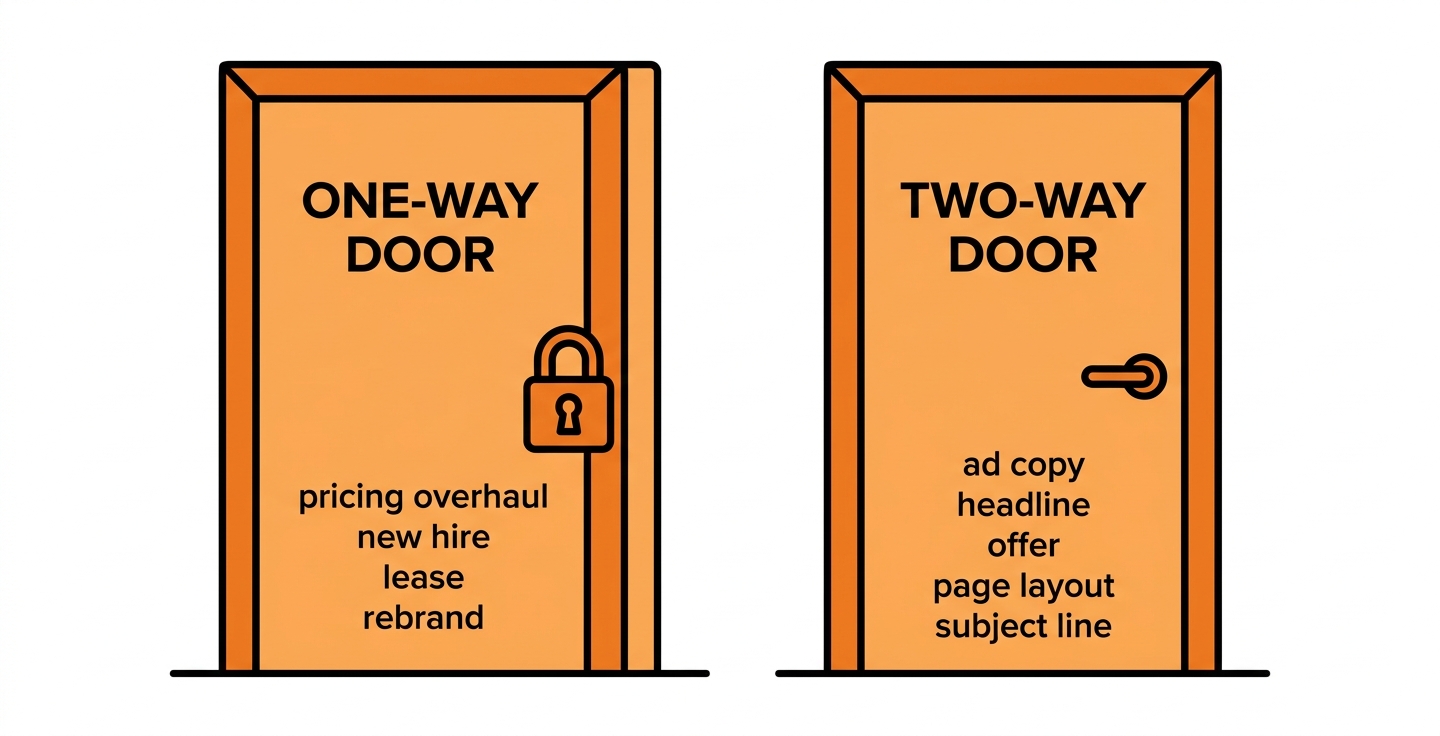
In 2015, Bezos gave Amazon’s teams a sharper tool for telling apart decisions worth slowing down for and decisions worth rushing. He split every decision into two types. Type 1 decisions are one-way doors: consequential, expensive to reverse, worth the deliberation they demand. Type 2 decisions are two-way doors — if the outcome disappoints, you walk back through and try something else.*3 The mistake he flagged was subtler than moving too fast: applying Type 1 caution to Type 2 decisions that never needed it.
The following year, he added the number that makes the framework usable day to day. Most decisions, he wrote, should be made with around “70 percent of the information you wish you had.”*4 Waiting for ninety costs real time, and a competitor is usually spending that time already testing.
A new headline on your homepage is a two-way door. A different offer in this month’s ad is a two-way door. A page layout, a subject line, a call-to-action button — all reversible in an afternoon, all cheap to undo. Most owners route them through the same slow approval process built for decisions that genuinely can’t be undone, like a hire, a lease, or a full rebrand.
01
TREAT THE TEST LIKE A TWO-WAY DOOR
Most marketing changes can be undone in the time it takes to edit a page. Before defaulting to “let’s think it over,” ask whether the change can be reversed by tomorrow. If it can, every week spent debating it costs more than a wrong answer would.
02
STOP WAITING FOR CERTAINTY
Chasing certainty on a two-way-door decision is usually a stall wearing a nicer outfit. Set a working rule: once you have roughly seven out of ten pieces of information you’d like, launch the test and correct from what comes back. Results from a live test beat guesses from a meeting every time. It’s the same threshold Amazon runs on: roughly 70% of the information you wish you had, not 100%.
03
BORROW PATTERNS, DON’T JUST WATCH COMPETITORS
Studying the business down the street only confirms what everyone already knows about your own market. Bhargava describes a trend as “a unique curated observation about the accelerating present” — pieced together from unrelated corners of the world, not copied from the nearest rival.*5 The businesses that pull ahead are usually borrowing a pattern from an industry with no obvious link to their own, and using it before it becomes standard practice everywhere else.
A pricing overhaul, a new hire, a multi-year lease — those stay one-way doors, and they deserve the slow, careful process Bezos reserved for Type 1 decisions. The argument is narrower: most of what stalls inside a marketing plan was never that kind of decision to begin with.
Speed compounds. A business that tests a new offer every month learns twelve things a year that a competitor waiting for the “right” campaign never learns at all. Pair that with genuine outside-industry pattern-spotting instead of competitor-watching, and the distance between the two businesses stops looking like luck.
WHO IS VOLP AGENCY
Volp Agency is a team of specialists in copywriting, design, paid traffic, and audiovisual production, built for exactly this kind of two-way-door work: testing headlines, offers, and creative fast enough that the data comes back before the opportunity closes, and reading patterns from outside your industry.
SOURCES
*1 Jeff Bezos, “1997 Letter to Shareholders,” reprinted in Invent and Wander (2020, introduction by Walter Isaacson). Introduced the “Day 1” standard Amazon repeated in every shareholder letter for the next two decades.
*2 Jeff Bezos, “2016 Letter to Shareholders,” Invent and Wander (2020). Defined “Day 2” as stasis followed by irrelevance, decline, and death.
*3 Jeff Bezos, “2015 Letter to Shareholders,” Invent and Wander (2020). Introduced the Type 1 (“one-way door”) and Type 2 (“two-way door”) decision framework.
*4 Jeff Bezos, “2016 Letter to Shareholders,” Invent and Wander (2020). Recommended deciding with around 70 percent of the information you wish you had.
*5 Rohit Bhargava, Non-Obvious: How to Think Different, Curate Ideas & Predict the Future (2017). Defined a trend as a unique curated observation of the accelerating present and outlined the five-step Haystack Method: Gather, Aggregate, Elevate, Name, Prove.