

For years, businesses poured energy into building polished feeds, growing follower counts, and chasing viral moments. And for a while, those things felt like proof that marketing was working. But the landscape has changed. Today, the businesses that actually grow are the ones treating marketing ROI not as a bonus metric, but as the baseline expectation. If your marketing efforts aren’t producing measurable revenue, they’re producing noise. And in a market this crowded, noise doesn’t pay the bills.
In this article, you’ll learn:
- Why vanity metrics give you a false sense of progress
- What performance indicators actually matter for growth
- How a marketing ROI mindset transforms your entire digital marketing strategy
- Practical steps to move from aesthetics to accountability
- How to build a revenue-driven marketing system that scales
The problem with chasing likes
Vanity metrics are seductive. A post goes viral, followers pour in, engagement spikes — and it feels like something meaningful just happened. But feelings aren’t financials.
Likes, shares, impressions, and follower counts measure attention. Attention has value — but only when it converts. The moment you mistake attention for growth, you’ve started optimizing for the wrong outcome. Many brands with stunning visuals and impressive vanity metrics are quietly struggling with stagnant sales, inconsistent cash flow, and a customer base that simply won’t grow. Why? Because their strategy was built around looking good rather than performing well.
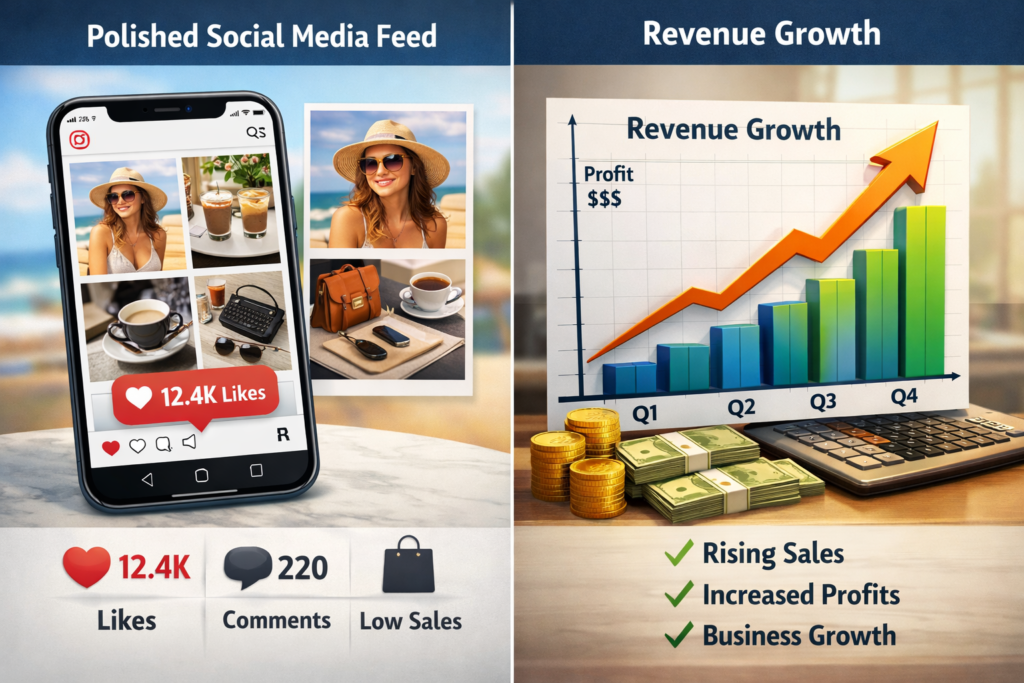
Vanity metrics create a dangerous illusion of progress. When your team celebrates a high reach number while conversions stay flat, you’ve lost sight of the actual goal: revenue. Likes won’t keep your doors open. But a smarter digital marketing strategy will.
What metrics actually matter
Shifting to marketing ROI starts with asking a different question. Instead of “How many people saw this?”, ask “What did this actually generate?” The metrics that drive sustainable growth are the ones tied directly to financial outcomes:
- Lead quality and volume — Are you attracting the right people into your funnel?
- Cost per acquisition (CPA) — How much does it cost to win a paying customer?
- Conversion rate — How effectively does your funnel turn interest into action?
- Customer lifetime value (CLV) — Are customers staying long enough to be profitable?
- Return on ad spend (ROAS) — How much revenue does each dollar of paid media produce?
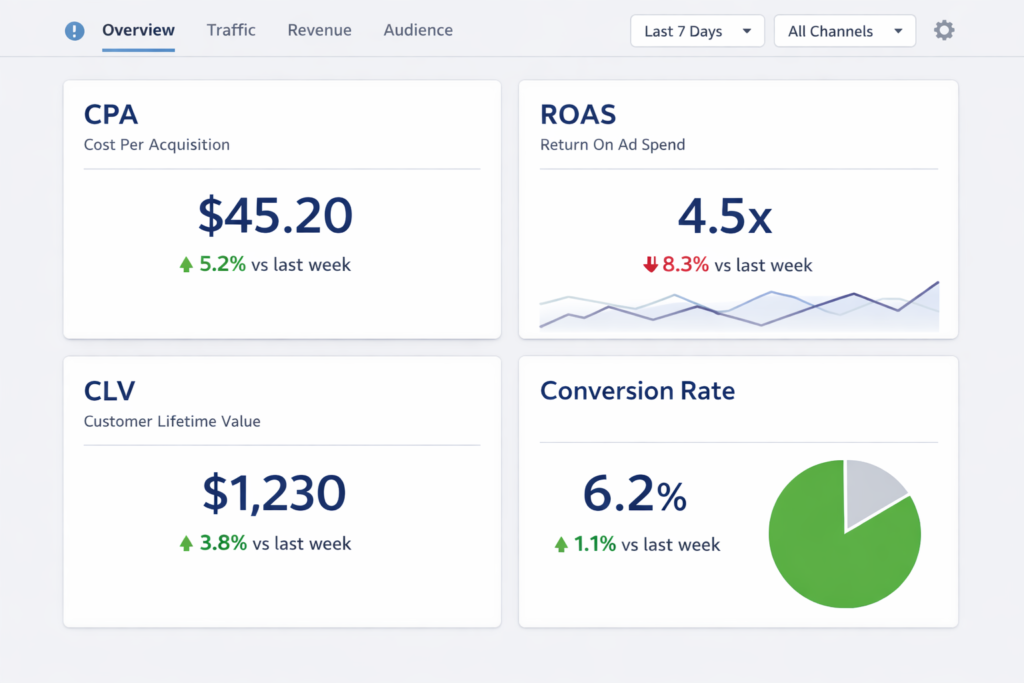
These numbers tell the real story of your digital marketing strategy. When you track them consistently, patterns emerge: which channels deliver quality lead generation, which messages convert, and which campaigns are quietly burning through budget. Pretty numbers in a deck don’t keep a business alive. Cash flow does.
How marketing ROI changes your entire approach
When marketing ROI becomes your north star, everything realigns. Creative decisions aren’t made by instinct alone — they’re informed by performance data. Budget flows toward campaigns that convert, not toward campaigns that look impressive in a report. Your digital marketing strategy stops being about “staying active” and starts being about driving measurable results.
This mindset shift also changes how teams talk about marketing internally. Conversations move from “Did people like it?” to “Did it perform?” That’s a healthier, more accountable dynamic — and it makes smarter resource allocation far easier.
Revenue-driven marketing also creates something most businesses are desperate for: predictability. When you know which levers to pull to generate a specific result, you stop relying on hope and start building a repeatable growth engine. That’s the difference between brands that scale and brands that stay stuck.
From feed aesthetics to profitable strategy: Where to start
Making the shift to a marketing ROI framework doesn’t mean blowing up everything you’ve built. It starts with a few fundamental changes in how you think about what marketing is actually for.
- Define success in financial terms. Follower growth isn’t a business outcome. More qualified leads, lower acquisition costs, higher customer retention — those are. Before any campaign launches, know the financial result you’re aiming for.
- Choose KPIs that connect to revenue. Tracking everything means understanding nothing. A focused digital marketing strategy relies on a short list of metrics that actually reflect the health of your business.
- Test, measure, and optimize relentlessly. Great marketing isn’t born — it’s built through iteration. Every campaign is a data point. Use it.
- Align messaging with your customer’s real problems. The most effective lead generation doesn’t come from beautiful creative — it comes from messages that speak directly to what your audience is actually struggling with. Relevance always beats aesthetics.
- Let data lead. Marketing ROI demands that you follow the numbers even when they disagree with your gut. Emotions can inspire ideas, but data decides what works.

Building a marketing system that actually pays off
The brands winning today aren’t just creative — they’re intentional. They invest in revenue-driven marketing systems where every touchpoint is designed to move someone closer to a purchase. That means paid traffic with clear conversion goals. Content built around lead generation, not just awareness. Messaging that connects consistently with the right audience at the right moment.
A strong digital marketing strategy grounded in marketing ROI gives you clarity, control, and the confidence to make decisions backed by real numbers. You stop guessing, stop hoping, and start building something that compounds over time.
Marketing that doesn’t generate revenue is only decoration. And your business deserves more than that.
Ready to grow?
We help businesses build marketing systems that drive revenue.
At Volp Agency, we help businesses shift from aesthetic-first marketing to strategy-first growth — building systems grounded in marketing ROI<, driven by data, and designed to scale. Whether you’re looking to improve lead generation, reduce acquisition costs, or build a more predictable revenue pipeline, we’ll work with you to make it happen.
Ready to build a marketing strategy that actually pays off?