


Claiming you’re better is a trap. Strive to be different instead.
Two companies competing for the same customer can say almost exactly the same thing. Same guarantee, same promise of quality, same claim of being the best choice in town. By the time that customer has to decide, only one of those companies gets remembered.
The problem with sounding like everyone else
Walk into any competitive service category and the messaging starts to blur together. Every website promises reliability, every truck says it has been trusted for decades. Even their proposal claims the highest standards and the fastest response. It doesn’t mean the message is false, but we can’t deny all of it sounds the same.
The instinct, when a market gets crowded, is to argue harder: sharpen the pitch, add another guarantee, repeat the word “quality” one more time on the homepage. But a louder version of the same message is still the same message, and customers stop processing messages that sound like the last five they heard. It’s just how our brain is hardwired.
The thing that actually sticks in a customer’s memory is rarely a claim at all. It’s something they can recognize before they can even put a name to it.
What memory research shows
In 1933, German psychologist Hedwig von Restorff ran an experiment that still shapes how marketers think about attention. Participants were shown a list of items, most similar to one another and one visually distinct. The distinct item was recalled at a far higher rate than any item from the uniform set, simply because it stood apart from its surroundings.*1
The finding, now known as the isolation effect, applies just as directly to brands. In a category where every competitor looks and sounds alike, being one more voice in a uniform set is close to invisible. Standing apart from that set is what earns a place in memory before a purchase decision is even made.
Decades later, research from the Ehrenberg-Bass Institute for Marketing Science, published by Byron Sharp in How Brands Grow, tested a version of this at the scale of real markets. The consistent pattern: brands grow less by convincing people they are superior and more by building distinctive assets — colors, shapes, sounds, taglines, structures — that make them instantly recognizable and easy to bring to mind at the moment of choice.*2
Superiority is an argument a customer has to accept. Distinctiveness is a shortcut their brain takes without having to think about it at all.
Three patterns show up wherever this plays out
01
The isolation effect in practice
A single element that looks nothing like its category becomes the thing people notice first and forget last. Inside a lineup of near-identical competitors, the one visual or verbal outlier earns disproportionate attention.
02
Distinctive assets outperform claims
A recognizable color, shape, or phrase gets a brand into consideration faster than an argument about quality ever could. Recognition happens in a fraction of a second. Persuasion takes far longer — time most customers never spend before choosing.
03
Distinction shows up everywhere or nowhere
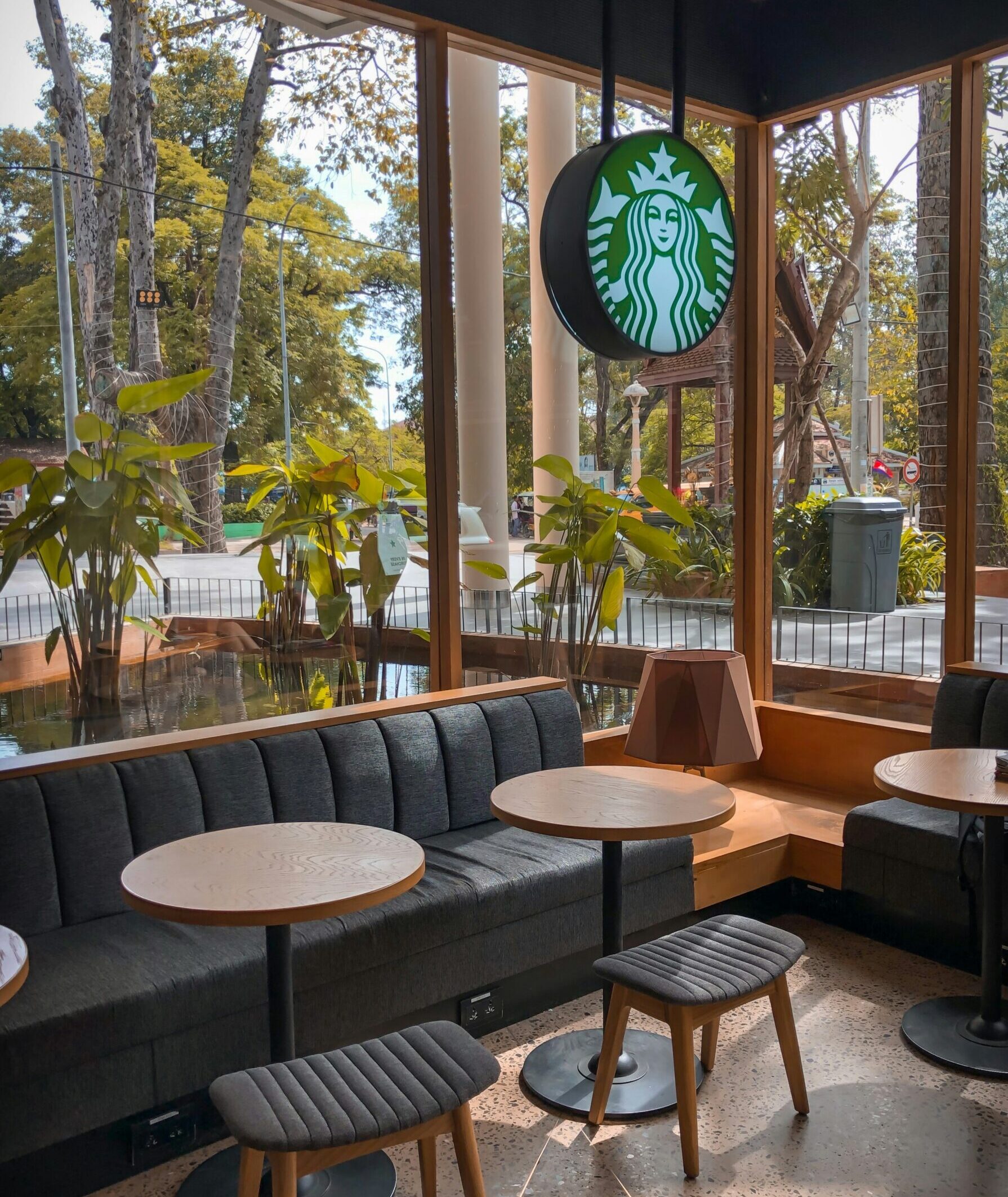
Starbucks took a commodity, coffee, and built a “third place” between work and home around it, turning a two-dollar product into something people are glad to pay five dollars for. Havaianas took a basic tropical sandal and turned it into a fashion object worn well beyond the beach. The Home Depot doesn’t win because it says it carries more than the competition. It wins because the size, the selection, and the help available deliver on that claim every time a customer walks in.
The same pattern holds in businesses that sell no physical product at all. Amazon rebuilt the entire experience of buying something: one destination for almost anything, with delivery that went from a week, to two days, to same-day, until waiting stopped feeling normal. Repeated consistently enough, that experience became the standard customers now expect everywhere else.

Real estate shows the same split: Running social ads for a new listing isn’t a differentiator anymore — most agents already do it, which makes it the baseline, not the edge. What actually changed the industry was companies like Opendoor, which removed the slowest parts of selling a home altogether: the listing, the showings, the weeks of negotiating. In their place, an offer and a closing date the seller could choose.
A service business has just as many chances to build that kind of experience: the way a phone call is answered, the clarity of a proposal, how a technician shows up, the comfort of an office or a waiting room, the tone of a follow-up message, whether a client leaves a meeting understanding exactly what they’re getting.
That kind of experience compounds when the same visual identity — colors, shapes, typography, organized consistently — shows up at every one of those moments. Get those attributes right for the audience a business is actually trying to reach, and they do more than help people recognize it later. They make it easier to remember, easier to like at first sight, and harder to overlook in a category where most competitors blur together. Visual consistency doesn’t replace the experience. It’s what carries that experience from one touchpoint to the next.
Each of those moments is either forgettable or distinct. A vague quote that only lists a price forces a customer to guess at what they’re actually getting. A quote that lays out exactly what’s included, in plain language, removes that guesswork, and a well-organized office or job site removes it again in person. That gap comes down to a business that has decided what its experience should feel like and delivers it the same way every time.
Consistency across those touchpoints is what turns a good impression into memory. The same standard of care, the same tone, and the same experience, repeated at every point of contact.
GET MORE QUALIFIED CLIENTS
Building that kind of consistency across a website, a proposal template, a truck wrap, a social feed, and every message a customer receives is not a one-person job, and it rarely happens by accident. Volp Agency is a team of specialists in copywriting, design, paid traffic, and audiovisual production who help service businesses build a brand customers can recognize before they read a single word of it.
Sources
*1 Hedwig von Restorff, Psychologische Forschung, 1933. Finding: an item perceptually isolated within a set of otherwise similar items is recalled at a significantly higher rate than items within the uniform set — the isolation effect.
*2 Byron Sharp, How Brands Grow: What Marketers Don’t Know, Oxford University Press, 2010, based on research from the Ehrenberg-Bass Institute for Marketing Science. Finding: distinctive brand assets build mental availability and predict purchase choice more consistently than claims of category superiority.