

The hero’s journey: What blockbuster films teach your brand
In 1975, George Lucas was stuck rewriting an early draft of Star Wars when a paperback he had been given years earlier finally clicked into place. Nineteen years later, on another floor of the same industry, a seven-page internal memo pointed a struggling Lion King crew toward the exact same shape of story.
A SCREENWRITER’S DISCOVERY, AND A FRIENDSHIP THAT OUTLIVED THE FILMS
Lucas had been circling Star Wars for years, rewriting draft after draft, when he read The Hero with a Thousand Faces, Joseph Campbell’s 1949 study of world mythology. He later said the book gave the story a structure he had been reaching for without being able to name it.
The two men stayed close for the rest of Campbell’s life. In a 1985 speech at the National Arts Club, Lucas introduced him to the room by calling him “my Yoda.”*1
Their conversations were eventually filmed at Skywalker Ranch and released as the PBS series The Power of Myth with Bill Moyers in 1988, introducing Campbell’s ideas to a television audience that had already watched them play out, without knowing it, in a movie theater eleven years earlier.
THE SEVEN-PAGE MEMO THAT REACHED KATZENBERG’S DESK
In 1985, a Disney story analyst named Christopher Vogler wrote an internal memo titled A Practical Guide to The Hero with a Thousand Faces, condensing Campbell’s structure into seven pages for the studio’s writers. Production chief Jeffrey Katzenberg found a copy and passed it along to key executives.*2
At the same time, elsewhere in the building, animators were already storyboarding a film about a young lion prince exiled from his kingdom. By the time Vogler moved into the animation division, The Lion King crew was building the story instinctively around the same twelve stages he had just put into a memo. Vogler later expanded that memo into the book The Writer’s Journey, first published in 1992 and revised in 1998 and 2007, now a standard reference on studio shelves.
THE PATTERN WASN’T INVENTED, IT WAS NOTICED
Campbell spent 38 years teaching comparative mythology at Sarah Lawrence College, studying myths from cultures with no contact with one another and finding they kept following the same shape: a hero leaves the world they know, faces trials in an unfamiliar one, and returns changed. He called it the monomyth.*3
The Hero with a Thousand Faces has sold close to two million copies and was later named by Time among the 100 most influential English-language books published since 1923.*4
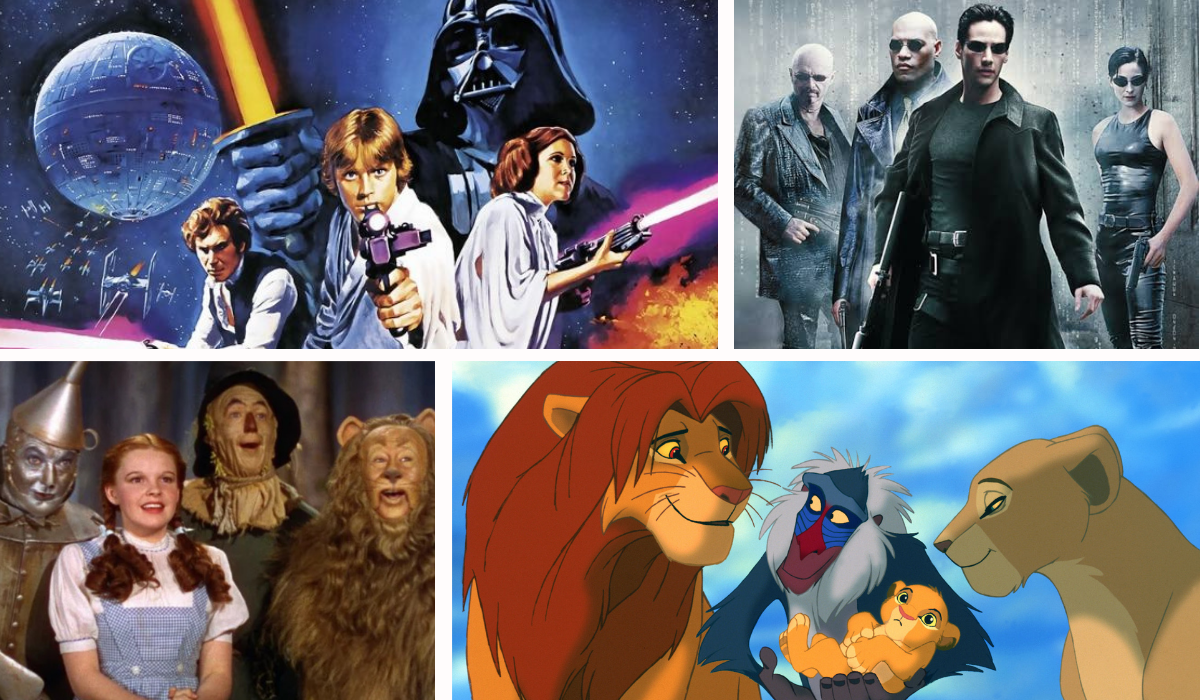
Once that three-part shape is visible, it is hard to stop noticing it. The Wizard of Oz, Star Wars, The Lion King, Harry Potter, The Matrix — different decades, different genres, the same arc of departure, initiation, and a transformed return.
THE NEUROSCIENCE BEHIND THE PATTERN
Paul J. Zak, a neuroeconomist at Claremont Graduate University, measured blood oxytocin in people before and after they watched character-driven video clips. Writing in Harvard Business Review in 2014, Zak reported that character-driven stories consistently trigger oxytocin synthesis*5, and the amount released predicted how much money viewers later chose to donate to a related cause.
Separately, Princeton neuroscientist Uri Hasson recorded fMRI scans of someone telling an unscripted story alongside scans of people listening to it. The listeners’ brain activity began to track the speaker’s, arriving a few seconds behind like an echo, and Hasson’s team found that the greater the anticipatory speaker-listener coupling, the greater the understanding*6. That mirroring effect disappeared entirely in moments when the story failed to land and communication broke down.
Two things stand out once the Hollywood history and the brain research sit next to each other.
01
THE BRAIN ON STORY
Character-driven stories measurably raise oxytocin levels, and that spike predicts real generosity afterward. Separately, brain scans show a listener’s activity syncing with a storyteller’s in real time — the closer that sync, the more the story actually lands.
02
THE TRANSLATION MOST BUSINESSES SKIP
In 2017, author Donald Miller adapted this same structure for marketing in Building a StoryBrand, with one deliberate flip: the customer is the hero, not the brand. The business plays the guide — the role Yoda plays for Luke, or Rafiki plays for Simba — arriving with a plan that helps the hero win.
Most service business marketing tells the opposite story. The homepage opens with company history. The about page lists years in business, certifications, headshots of the team. Every one of those facts can be true, and none of them gives the customer anything to do but read.
The businesses whose marketing gets remembered flip that structure: the customer arrives with a problem, the business hands them a plan, and the website, the video, and the ad all point to one outcome the customer can picture winning for themselves. That’s the same architecture a Skywalker Ranch friendship and a seven-page Disney memo pointed to decades apart, now aimed at a sales page instead of a box office.
WHO IS VOLP AGENCY
Volp Agency is a team of specialists in copywriting, design, paid traffic, and audiovisual production who build a business’s verbal and visual identity around that same working principle: the customer is the hero of the story, and every website, video, and ad exists to hand them a clear plan for winning. That structure gets translated into messages built for the specific audience and niche they’re written for, aimed at one outcome — the customer sees themselves in it.
SOURCES
*1 Joseph Campbell Foundation, jcf.org. Finding: George Lucas read The Hero with a Thousand Faces while drafting early versions of Star Wars and credited it with giving the story its structure. In a 1985 speech at the National Arts Club, Lucas called Campbell “my Yoda.” Their friendship was later documented in the PBS series The Power of Myth with Bill Moyers, filmed at Skywalker Ranch and broadcast in 1988.
*2 Christopher Vogler, chrisvogler.wordpress.com (author’s own account). Finding: in 1985, Vogler, then a Disney story analyst, wrote a seven-page internal memo summarizing Campbell’s monomyth; production chief Jeffrey Katzenberg found a copy and circulated it to studio executives, while The Lion King (1994) animators were independently building the film’s storyboard around the same twelve-stage structure. Vogler later expanded the memo into the book The Writer’s Journey (Michael Wiese Productions, 1st ed. 1992; revised 1998 and 2007).
*3 Archania.org; Encyclopaedia Britannica; Joseph Campbell Foundation. Finding: Campbell taught comparative mythology at Sarah Lawrence College for 38 years and, comparing myths from unconnected world cultures, concluded they share a common narrative structure he termed the “monomyth.”
*4 FIU Calendar (calendar.fiu.edu); Wikipedia, citing Time magazine (2011). Finding: The Hero with a Thousand Faces (1949) has sold close to two million copies and was named by Time among the 100 most influential English-language books published since 1923.
*5 Paul J. Zak, “Why Your Brain Loves Good Storytelling,” Harvard Business Review, Oct. 28, 2014. Finding: character-driven stories consistently trigger oxytocin synthesis, and the amount released predicted participants’ willingness to help or donate afterward. Correlational finding from controlled lab studies, not a claim about all stories or all audiences.
*6 Stephens, Silbert & Hasson, “Speaker-listener neural coupling underlies successful communication,” PNAS 107(32):14425-14430, Aug. 10, 2010. Finding: fMRI scans show a listener’s brain activity anticipating and mirroring a speaker’s; stronger anticipatory coupling predicted greater comprehension, and the coupling weakened when communication broke down.
*7 Donald Miller, Building a StoryBrand, HarperCollins Leadership, 2017; HarperCollins Leadership release via BusinessWire, Nov. 21, 2024. Finding: Miller’s StoryBrand framework repositions the customer as the hero of the marketing narrative and the brand as guide; the publisher reports the framework has reached over one million business leaders since its release.