


3 questions to set your marketing priorities this quarter
It is a quarter to eight on a Tuesday morning, and before the coffee has finished brewing your inbox already holds an invitation to a webinar on short-form video, a note from a software rep who swears the new follow-up automation will pay for itself within a month, and a forwarded article, sent by a friend with the best of intentions, about a company that doubled its leads with a podcast nobody else in its field had thought to start.
TOO MANY GOOD IDEAS
Nothing in that inbox is foolish, and that is exactly what makes it so hard to handle. Every one of those ideas has worked for somebody, somewhere, and every one arrives wrapped in a case study that makes it sound like the obvious next move for a business like yours, so the natural response, the one most of us fall into without ever deciding to, is to say yes to a little of every one of those marketing tactics and hope the pile sorts itself out.
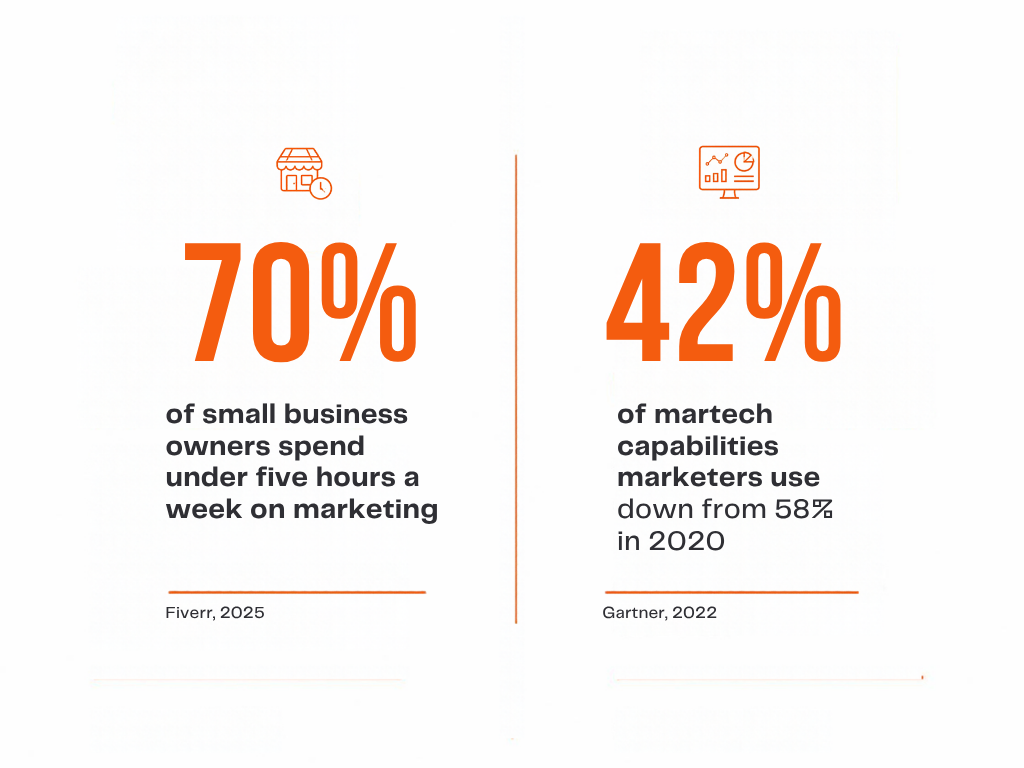
The pile does not sort itself out, and the people living inside it tend to know that. A 2025 survey of nearly 6,000 small business owners and entrepreneurs in 25 countries found that seven in ten spend fewer than five hours a week on marketing,*1 which means that whatever you decide to do with those hours has to carry a great deal of weight, and every tactic you start but never finish quietly takes a share of them.
The same thing happens with money. Gartner’s 2022 marketing technology survey, which polled 324 marketers, found they were using just 42 percent of the capabilities in the tools they had already bought, down from 58 percent two years earlier, with overlapping products and sheer complexity among the reasons they gave.*2 A tool you subscribed to in a burst of optimism and never fully learned is not a neutral thing to own, because it keeps billing you, keeps asking for your attention, and keeps reminding you of a plan you quietly dropped.
Then there is the expense that never shows up on any statement, which is focus. Each of these marketing tactics asks you to learn something, make something, check something, and hold one more thread in your head while you are also running a crew, answering the phone and chasing an invoice, and by the end of the quarter you can find yourself with six half-built efforts and no clear idea which of them, if any, brought in a single job.
Rohit Bhargava, the trend curator behind the Non-Obvious book series, has spent years studying how people make sense of this kind of flood, and one detail of his method is oddly reassuring for anyone who feels behind. His Haystack Method begins with a year of gathering stories, but the gathering is only the first step, because the material is then organized into themes, connected, and validated before anything gets called a trend,*3 which is how the 2015 edition of his report turned a year of reading into fifteen ideas.*4
He also describes a habit he calls being fickle, which means saving an interesting idea for later without forcing yourself to decide on the spot what it means, since the analysis tends to work better after a pause.*5 Pair that with another of his habits, being thoughtful, which asks you to take a moment to form a real point of view before you respond,*5 and you have a fair description of what a busy owner needs when the webinar invitation lands: permission to leave it unanswered today, and a few good questions to ask when the time comes.
THREE QUESTIONS BEFORE YOU DECIDE
The questions below are our own, built on the same instinct, and the useful thing about them is how cheap they are to run. You can get through all three in about ten minutes with a pen and the back of an envelope, and a new idea has to pass every one of them before it earns a place among your marketing priorities.
The order matters a little, since each question is harder to fudge than the one before it, so we will take them in turn.
01
DOES IT SERVE MY CUSTOMER?
Start with the person on the other end of the work you do, and be specific enough that you could picture them: the homeowner with a failing system on a cold night, the office manager comparing three quotes before lunch, the family that needs an answer today and has never hired anyone like you before. Then ask whether this particular tactic would meet that person where they already are, in the moment they are looking for help, because a channel can be fashionable and still be a place your customers never visit when they are making this kind of decision.
A good way to test it is to think about the last five people who hired you, how each of them found you, how long they took to decide, and what they wanted to know. If the new idea speaks to that path, you are on solid ground, and if it speaks to some other kind of customer you do not currently have, it may still be a fine idea for someone else’s business, and it can wait.
02
DOES IT SERVE MY GOAL?
This one sounds obvious until you try writing the goal down, and a surprising number of us discover that the real target is fuzzier than we thought, something like “be more visible” or “grow,” which is the kind of target any tactic can claim to hit. Marketing goals worth testing against have a number and a deadline attached, such as ten more qualified calls a month by the end of the year, a fuller calendar in the slow season, or a better mix of jobs that carry a healthy margin.
Once the goal is on paper, hold the tactic up to it and ask how many steps sit between the two. A brand video may be a lovely thing to own, but if the goal is more booked appointments next quarter, the road from one to the other is long and winding, whereas answering every new inquiry within the hour sits almost on top of the result. Both have their place, though only one of them belongs on this quarter’s list.
03
CAN I MEASURE IT?
Before anything launches, decide how you will know whether it worked, and decide it while you are still curious and not yet invested, because afterward every result starts to look like a success to the person who paid for it. The measure can be modest: calls that mention the campaign, form submissions from one particular page, quotes requested, jobs booked, or what each lead you can trace back to the effort ended up costing you.
If you cannot think of any way to count the outcome, that is useful information in itself, because it means you would be running on feelings for three months, and feelings are very good at defending the things we have already spent money on. Give the idea a fixed window, ninety days is often enough, and write down in advance what result would make you keep it, change it or drop it, so the decision is half made by the time the numbers arrive.
A SHORT LIST OF MARKETING PRIORITIES
With the questions in hand, the list almost builds itself, though it helps to follow a rhythm. First, empty your head onto a single page: every idea, tool and tactic you have been carrying around, the webinar, the automation, the podcast, the half-finished plan to redo the website, written down without judgment, which is the gathering step of Bhargava’s method in miniature.
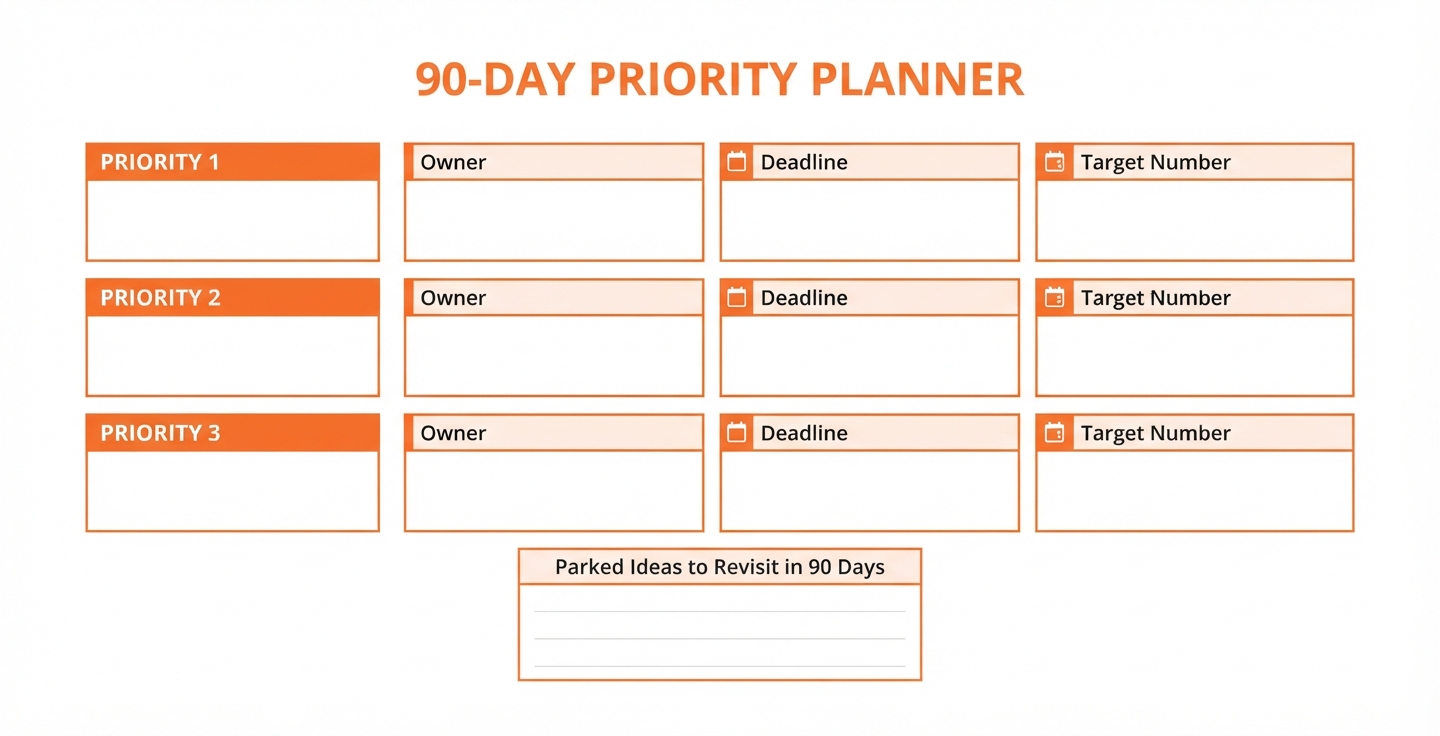
Next, run each item through the three questions and cross out anything that fails even one, being gentle with yourself about it, since an idea that fails today may pass next quarter when the customer or your marketing goals have changed. What survives is usually a handful of items, and the final move is to pick no more than three of them as your marketing priorities, put an owner and a date beside each, and park the rest somewhere you can find them again in ninety days.
It helps to know that a written plan seems to make a difference. A 2025 survey of 245 U.S. small business owners by the marketing software company Enji found that only one in five rated their marketing as very or extremely effective, and the company’s summary ties that minority to having a plan and following through on it.*6 It is a small sample from a vendor with a product to sell, so we would read it as a signal, since it falls short of proof, but it points the same direction as everything above: a short, written marketing plan is far easier to follow than a loose intention.
None of this takes a special talent, only a willingness to leave good ideas on the shelf for a while, which is harder than it sounds when the person making the decision is also the person who has to live with the results. Small business owners tend to be attached to the ideas they have already put money into, and they have the least spare attention in the whole business, so the sorting often goes better with a second pair of eyes that has no history with the pile.
That is a natural place for an outside partner to sit, somewhere between the inbox and the calendar, helping decide which two or three marketing priorities deserve the next ninety days.
STOP CHASING EVERY TREND AND CHOOSE WHAT COUNTS
Volp Agency is a team of specialists in copywriting, design, paid traffic, and audiovisual production, and a good share of the work with service business owners starts with the conversation this article describes: sitting down with the pile of ideas, running each one through the three questions, and agreeing on the two or three that deserve this quarter’s budget. From there, our team builds and tests what made the list, so you end up with a clear marketing plan, a short set of campaigns you can measure, and a good part of your week back.
Sources
*1 Fiverr International Ltd., “Fiverr Small Business Month Survey,” press release, May 8, 2025. Nearly 6,000 small business owners and entrepreneurs across 25 countries, surveyed between July 2024 and March 2025; 70% reported spending less than five hours a week on marketing. Self-reported and vendor-run, and includes respondents outside the U.S.
*2 Gartner, Inc., “2022 Marketing Technology Survey,” press release, October 3, 2022. 324 marketers surveyed in May and June 2022 reported using 42% of their martech stack capabilities, down from 58% in 2020; 30% of respondents cited overlapping solutions and 27% cited ecosystem complexity. Not limited to small businesses, and the data is from 2022.
*3 SXSW, “Looking Out For The Non-Obvious,” 2020 Featured Speaker profile of Rohit Bhargava, 2020. Describes the Haystack Method as a year-long process of gathering stories, organizing them into themes, identifying connections and validating the material. Third-party summary; see Bhargava, Non-Obvious Megatrends (2020), for the full method.
*4 Media review of Rohit Bhargava, Non-Obvious: How to Think Different, Curate Ideas and Predict the Future (2015), Interdisciplinary Journal of Partnership Studies, 2016. Notes that the 2015 Non-Obvious Trend Report lists and describes 15 new ideas.
*5 Rohit Bhargava, “The 5 Habits of Non-Obvious Thinkers,” rohitbhargava.com (framework from Non-Obvious Megatrends, 2020). “Be fickle” is described as saving ideas for later without overanalyzing them in the moment; “be thoughtful” as taking time to develop a point of view. The three questions in this article are Volp’s own and are not Bhargava’s.
*6 Enji, “The State of Small Business 2025,” press release via ABNewswire, April 29, 2026. 245 U.S. small business owners surveyed in September 2025; 20% rated their marketing very or extremely effective, and the company links effectiveness to having a plan and following through. Small sample and vendor-run.